
The Complete Guide to Calculating Zakat on Gold: Nisab, Rules, & Live Rates
Learn the exact rules for calculating Zakat on 24k, 22k, and 18k gold jewelry and investments. Understand the 85-gram Nisab threshold with our free tools.
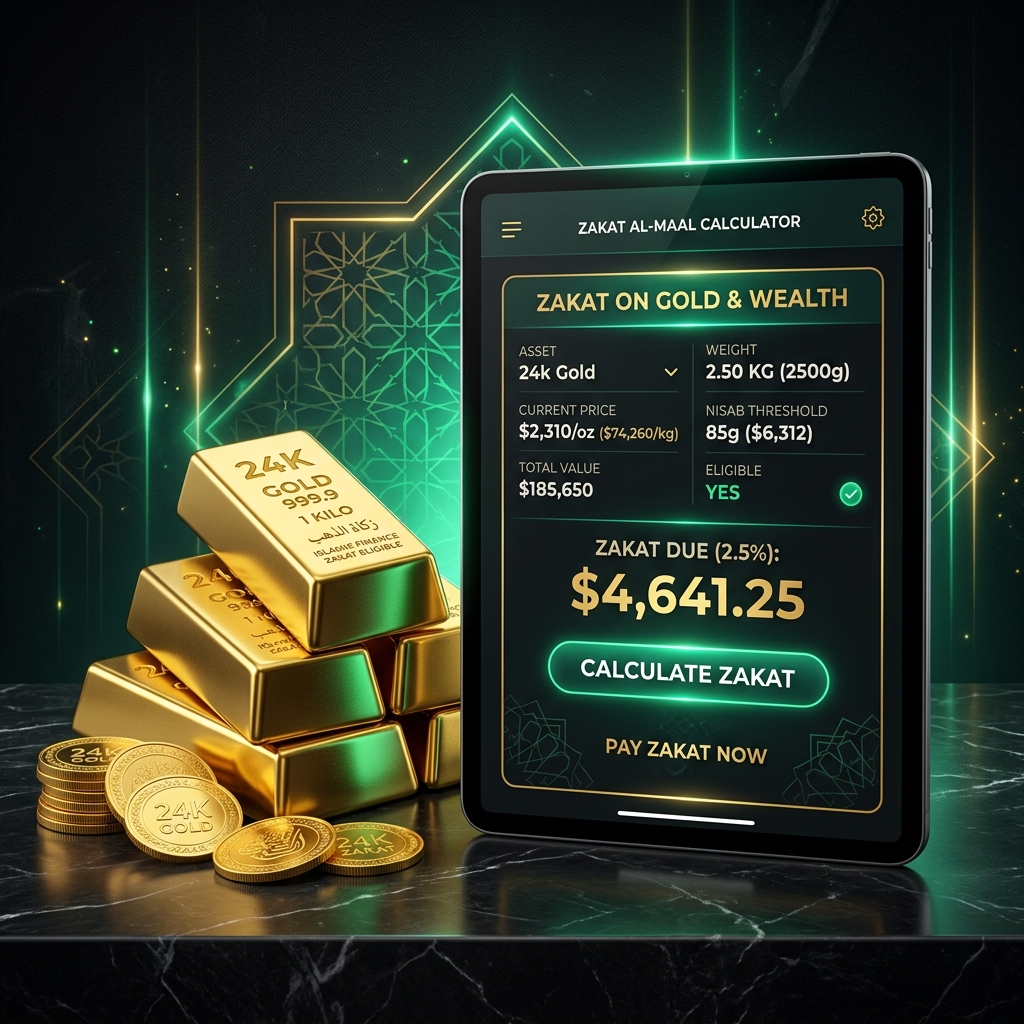
Calculating Zakat on gold is one of the most critical financial obligations for Muslims globally. Whether you reside in Saudi Arabia, the UAE, or anywhere else, understanding the precise conditions under which gold becomes Zakatable (subject to Zakat) requires both religious knowledge and accurate financial data. Zakat is not merely a charitable donation; it is a fixed 2.5% wealth tax applied to specific assets that reach a minimum threshold, known as the Nisab, and have been held for a full lunar year (Hawl). In this deep-dive guide, we will explore how to calculate Zakat on different karats of gold (24K, 22K, 21K, and 18K), the difference between investment gold and wearable jewelry, and how to use live market data to fulfill your obligations accurately.
1. The Nisab Threshold for Gold
The Nisab is the minimum amount of wealth a Muslim must own before Zakat becomes obligatory. For gold, the Nisab was historically set at 20 Mithqal, which modern Islamic scholars have universally calculated to equal exactly 85 grams of pure (24K) gold. If your total gold ownership equals or exceeds 85 grams, you are required to pay 2.5% of its total current market value as Zakat.
It is highly important to note that the Zakat is paid based on the current market value of the gold on the day the Zakat is due, not the price at which the gold was originally purchased. Because gold prices fluctuate constantly on the global commodities exchange, relying on outdated prices can result in underpaying or overpaying. You must track the live spot price. For precise, real-time rates, you can refer to our live Saudi gold rates or UAE live gold market data.
2. Investment Gold vs. Wearable Jewelry (Huliyy)
One of the most frequently asked questions is whether women must pay Zakat on the gold jewelry they wear regularly. The ruling on this depends heavily on the specific school of Islamic jurisprudence (Madhhab) and the local customs (Urf).
- Investment Gold: There is absolute consensus among all scholars that gold held for the purpose of investment or wealth preservation—such as 24K gold bars, coins (like the sovereign or PAMP Suisse bars), or gold biscuits—is always subject to Zakat, provided it meets the 85-gram Nisab.
- Wearable Jewelry (Huliyy): The rules regarding jewelry worn for personal adornment are more complex. According to the Hanafi school of thought, all gold jewelry, regardless of whether it is worn or stored, is subject to Zakat if it reaches the Nisab. However, the Shafi'i, Maliki, and Hanbali schools generally hold that gold jewelry acquired for lawful personal use and worn within customary limits is exempt from Zakat. If the amount of jewelry is considered excessive or extravagant by local societal standards, the excess amount becomes Zakatable.
3. Calculating Zakat Across Different Karats (22K, 21K, 18K)
The 85-gram Nisab threshold applies specifically to pure 24-karat gold. However, most jewelry in regions like Dubai or Riyadh is crafted from 22K or 21K gold because pure 24K gold is too soft for intricate designs. How do you calculate the Nisab for these alloys?
To be completely accurate, you must calculate the exact amount of pure gold within the alloyed pieces. For example, 22K gold is 91.6% pure gold (22/24). If you own 100 grams of 22K gold, you effectively own 91.6 grams of pure 24K gold. Since 91.6 grams is greater than the 85-gram Nisab, Zakat is due. Conversely, if you own 100 grams of 18K gold (which is 75% pure), the pure gold content is only 75 grams. This falls below the 85-gram Nisab, meaning no Zakat is due (unless combined with other assets like cash).
To calculate the monetary value owed, you simply multiply the total weight of your gold by the current live spot price for that specific karat, and then calculate 2.5% of that total. For instance, if you have 100g of 21K gold, you multiply 100 by the live price of 21K gold, and pay 2.5% of the resulting fiat currency value.
4. Combining Assets: Gold, Silver, and Cash
In modern Islamic finance, many scholars advise that if an individual owns a mix of gold, silver, fiat currency (cash in bank accounts), and tradable business inventory, the values of these liquid assets should be combined to determine if the overall Nisab is met. If the total combined value of your cash and gold exceeds the monetary equivalent of 85 grams of gold, you must pay 2.5% on the entire combined sum.
5. Automating the Process
Performing these mathematical calculations manually across different purities and fluctuating global commodity rates can be daunting and prone to human error. To ensure absolute religious compliance and financial accuracy, we highly recommend using our Advanced Gold Zakat Calculator. This tool automatically pulls the live, institutional-grade gold spot prices from global markets, applies the exact mathematical ratios for 24K, 22K, 21K, and 18K purities, and accurately generates your exact Zakat liability in either fiat currency (SAR, AED, USD, etc.) or equivalent gold grams.